
Salary negotiation script
Generate a confident, professional script to ask for a raise based on your achievements.
Your Negotiation Script
Related guides
Asking for a raise is universally uncomfortable. Mostly because people try to wing it, and winging it usually ends with asking for 'more money' because you feel you 'deserve it'—which is a request, not a negotiation. When you enter a room without a structured script, it is incredibly easy for an experienced manager to derail the conversation, make you feel defensive, or quickly end the meeting with a vague promise to 'look into it.'
This generator helps you build a structured, professional script. You input your current salary, your target, and exactly what you've delivered recently. It returns a confident script that focuses the conversation on business value, not personal feelings or market inflation. Business value is the only metric that human resources and executive leadership care about when approving a budget increase for an existing employee.
By using a script, you take emotion out of the equation. You aren't begging for a favor; you are presenting a business case. You are highlighting that your responsibilities have grown, your output has increased, and your compensation needs to be adjusted to reflect the current reality of your role.
Why scripts work better than winging it
A script isn't meant to be read robotically. It's meant to structure your thoughts so you don't panic and backtrack when your manager goes silent. Silence is a common negotiation tactic used to make the other party uncomfortable enough to negotiate against themselves. If you have a script, you state your case, state your number, and then you remain silent.
Good scripts do three things: state the number clearly, tie the number to recent outperformance, and end with a question that forces a real response. By ending with 'Can we outline a plan to make this happen?', you force your manager to either agree to the premise or explicitly deny it, rather than just nodding and changing the subject.
Practice your script out loud at least ten times. Stand in front of a mirror or practice with a friend. The first time you say your target salary out loud, it will feel terrifying. By the tenth time, it will feel like a simple statement of fact.

Do your market research first
Before you ask for $80,000, you need to know if $80,000 is actually what someone with your title and experience commands in your city right now. You cannot negotiate effectively if your number is based on what you *want* rather than what the market dictates.
Check multiple sources: Glassdoor, levels.fyi, PayScale, and actively talk to recruiters on LinkedIn. If your ask is grounded in real data, your manager has an easier time getting it approved by HR. When HR asks your manager why you deserve a 15% raise, your manager needs to be able to say, 'Because if they leave, it will cost us 20% more to replace them at current market rates.'
Never use your personal financial situation as a justification for a raise. Your rent increasing, your student loans, or your desire to buy a house are not your employer's problem. Their only concern is the market rate for the labor you provide.

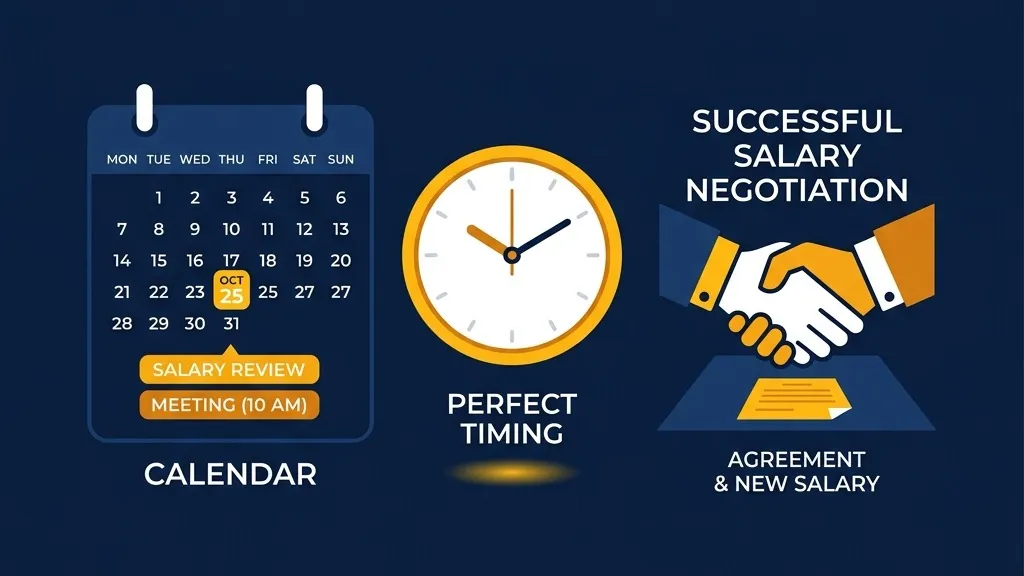
Timing is everything in negotiation
The biggest mistake employees make is asking for a raise during their annual performance review. By the time your review happens, the budget for the year has already been locked in months ago. Your manager might want to give you a raise, but their hands are tied by corporate finance.
The ideal time to ask for a raise is 3 to 4 months before the end of your company's fiscal year, right as budgets for the next year are being drafted. This allows your manager to write your raise into the upcoming budget.
Alternatively, the best non-cyclical time to ask for a raise is immediately after you have delivered a massive win for the company. If you just saved a major client, launched a successful product, or covered the duties of someone who quit for three months, your leverage is at its absolute peak. Do not wait for a formal review cycle when your leverage is high.
Body language and vocal confidence
How you deliver the script is just as important as the words themselves. If you apologize, fidget, or use a rising inflection at the end of your sentences (making statements sound like questions), you undermine your own authority.
Sit up straight, maintain steady eye contact, and keep your hands visible and still on the desk. When you state your target salary, drop your pitch slightly at the end of the sentence to signify finality.
Do not use filler words like 'just', 'maybe', or 'I think'. Instead of saying 'I was just hoping we could maybe look at my salary', say 'I'd like to discuss my compensation.' Confidence signals that you know your worth and are prepared to advocate for it.

What to do if they say no
A 'no' is rarely a final 'no forever'. It usually means 'no right now' or 'we don't have the budget'. The worst thing you can do when hearing 'no' is to apologize or immediately back down.
If the answer is no, ask the crucial follow-up: 'What specific milestones or metrics do I need to hit in the next 6 months for us to revisit this?' Force them to give you a quantifiable roadmap to your target salary.
If they refuse to give you a roadmap, or if they give you impossible metrics, you have your answer. The company does not value you at the level you want to be valued. It is time to take your updated resume and your market research and find an employer who will.
Frequently asked questions
When is the best time to ask for a raise?
Typically 3-4 months before your annual review (before budgets are locked in), or immediately after delivering a major, highly visible project. Never wait until the actual review, as the budget is already finalized by then.
Should I mention inflation?
Generally, no. Companies don't give raises based on your personal expenses or inflation; they give raises based on the value you provide. Focus entirely on your performance and current market rates for your exact role.
What if my manager agrees but HR blocks it?
Ask your manager for a concrete timeline for when it can be approved. If a base salary increase is truly blocked, pivot to negotiating for alternative compensation: a one-time performance bonus, extra paid time off, a better job title, or a guaranteed remote work schedule.
Is it bad to give an exact number rather than a range?
Give an exact number. If you give a range (e.g., 'I want between $80k and $90k'), the company will immediately anchor to the lowest number in that range. Always state your exact target, or even slightly above it, to leave room for them to negotiate down to your true target.
Should I threaten to quit if I don't get the raise?
Never bluff. Unless you have a signed offer letter from another company in your hand and are fully prepared to walk out the door that day, do not issue ultimatums. Ultimatums permanently damage your relationship with your manager.