

Reading is a skill, not a fixed talent. Most adults read the way they were taught at school and never revisit it, which is why so many capable people finish a report and realise they cannot remember a single point from it.
Improving is easier once you accept that "reading better" is really three separate abilities: speed, comprehension and retention. They need different fixes. Trying to improve all three at once is why most attempts fail. This guide explains which one to work on, and gives you practical methods for each.
1. Work Out Which Problem You Actually Have
Before changing anything, identify what is going wrong. Read four pages of something reasonably demanding, then close it and write down the main points from memory.
- You understood it but it took a long time. Your problem is speed.
- You reached the end unsure what it said. Your problem is comprehension.
- You understood it then, but remember little now. Your problem is retention.
- You kept drifting off and re-reading lines. Your problem is attention, and it must be fixed first.
Most people who think they read too slowly actually have an attention problem. They read a paragraph three times because their mind wandered, not because their eyes are slow. Fixing focus alone often makes people noticeably faster with no speed training at all.
2. Build the Habit Before Chasing Technique

No technique helps if you only read occasionally. Consistency does more for reading ability than any method, because comprehension improves through volume.
Three things make a reading habit stick:
- Attach it to something you already do. After your morning coffee, on the commute, or the fifteen minutes before sleep. A habit tied to an existing routine survives a busy week; a habit tied to spare time does not.
- Start smaller than feels worthwhile. Ten minutes, or five pages. The goal for the first month is not volume but never missing two days in a row.
- Keep the book physically visible. On the pillow, on the kitchen table, in your bag. Out of sight genuinely does mean out of mind.
Reading also competes with everything else you want to do, which is usually the real obstacle. If your evenings disappear before you reach the book, our guide to balancing work and hobbies covers how to protect time for things that matter but have no deadline.
3. Choose Material at the Right Level
People abandon reading because they pick books that are too hard, too dull, or both. A good rule is that you should understand most of what you read without a dictionary, but meet a few unfamiliar words on each page. That is the level where you improve without becoming frustrated.
You are also allowed to stop reading a book you dislike. Finishing out of duty teaches your brain that reading is a chore, which is the opposite of what you want. Put it down and choose something else.
If you are reading to develop professionally, mix formats deliberately: books for depth, long articles for current thinking, and industry newsletters for keeping up. Depth is what most people are short of, because it is the least convenient.
4. Read Actively Instead of Passively
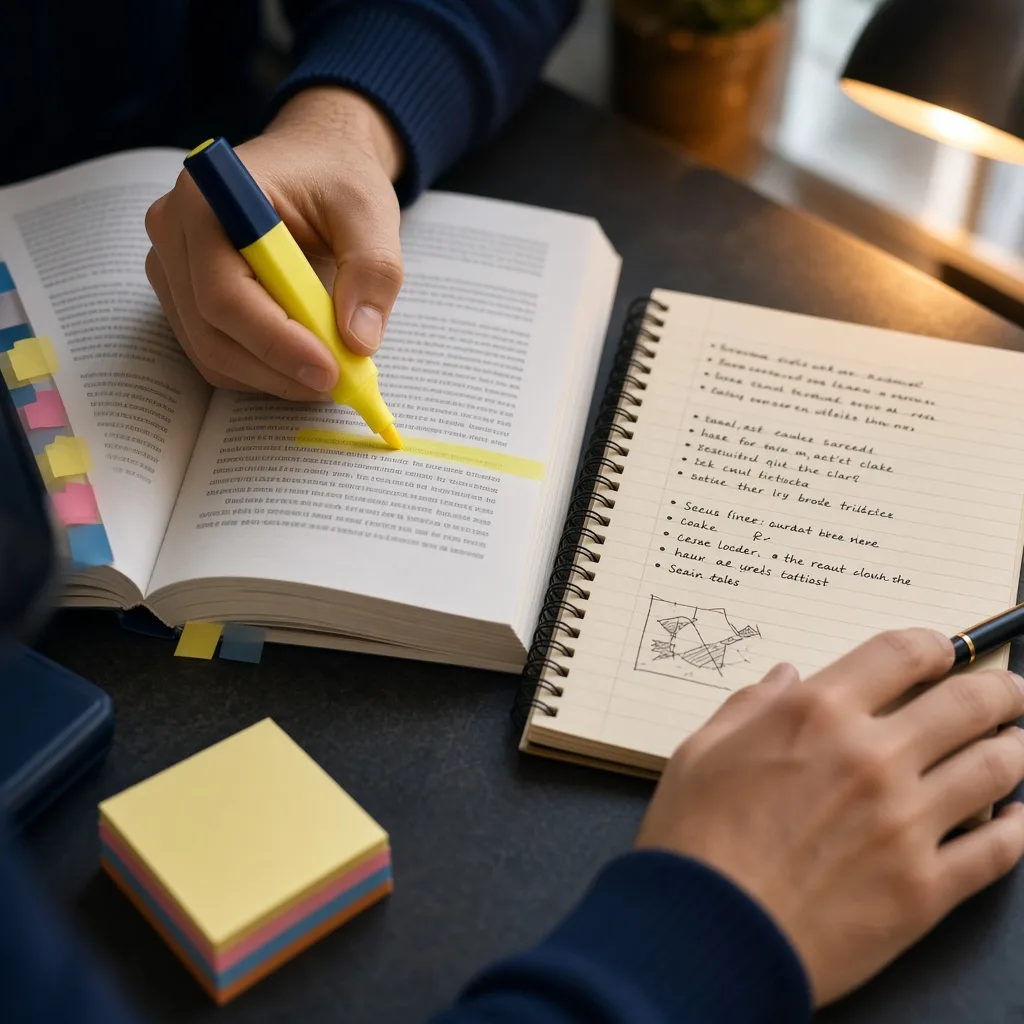
Passive reading means running your eyes over words and hoping something stays. Active reading means doing something with the text as you go, and it is the single biggest improvement available to most readers.
A simple version that works for non-fiction:
- Preview first. Spend two minutes on the contents, headings and first lines of each section. Knowing the shape of the argument makes the detail much easier to absorb.
- Turn each heading into a question. A section called "Cash flow problems" becomes "what causes cash flow problems?" You then read looking for an answer, which keeps attention anchored.
- Mark sparingly. Highlighting half a page achieves nothing. Limit yourself to one or two marks per page so the choice forces you to judge what matters.
- Summarise from memory. At the end of each chapter, close the book and write two or three sentences in your own words. If you cannot, you did not understand it — and that is useful to know immediately rather than a month later.
Writing the summary in your own words is the part that does the work. Copying a sentence out is almost useless; rephrasing it forces your brain to process the meaning.
5. Grow Your Vocabulary Deliberately
Comprehension is limited by vocabulary. If you meet several unknown words in a paragraph, you will lose the thread however hard you concentrate.
Work out meaning from context first — the surrounding sentences usually give you enough, and guessing before checking helps the word stick. Look it up only if the word seems important or keeps appearing. Then collect the ones worth keeping in a single list with the sentence you found them in, because words remembered in context are far easier to recall than words remembered as definitions.
Reading widely across different subjects does more for vocabulary than any app, since the words arrive attached to meaning rather than in isolation.
6. Read Faster Without Losing the Meaning
Genuine speed gains come from removing inefficiencies, not from forcing your eyes to move quickly. Three habits are worth fixing:
- Reduce sub-vocalisation. Most people silently pronounce every word, which caps them at speaking pace. You cannot eliminate it entirely, but with practice you can stop pronouncing common words and read those visually instead.
- Stop back-skipping. Re-reading lines automatically is a large hidden cost. Use a finger or pen under the line to keep your eyes moving forward. If you genuinely missed something, finish the paragraph before going back.
- Read in groups of words. Take in three or four words per glance rather than one. This feels uncomfortable for a week and then becomes normal.
Be sceptical of claims about reading thousands of words per minute. Research consistently finds that beyond roughly 400 to 500 words per minute, comprehension falls sharply — what is described as very fast reading is usually skimming. Skimming is a legitimate tool, but it is not the same as reading.
7. Remember What You Read

Forgetting is normal. Without deliberate effort, most of what you read disappears within a few weeks. Three methods reliably slow that down.
Recall instead of re-reading. Testing yourself on what a chapter said is far more effective than reading it again, even though re-reading feels more productive. Ask yourself what the main argument was and only then check.
Space it out. Revisit your notes the next day, a week later, then a month later. Brief spaced reviews beat one long session by a wide margin.
Explain it to someone. Teaching exposes gaps instantly, which is why book clubs and discussion groups work so well. If nobody is available, write a short summary as though explaining it to a colleague.
Keep one place for anything worth keeping — a notebook or a single document. A note you cannot find again may as well not exist.
8. Protect Your Attention
Sustained reading is harder than it used to be, mainly because most of us have trained ourselves on short, constantly refreshing text. Rebuilding the capacity for long-form attention takes a few weeks.
Put the phone in another room rather than face-down on the table, since the effort of resisting it is itself a distraction. Read in timed blocks of twenty-five minutes with a short break, which is easier to commit to than an open-ended session. If your mind wanders, mark the line and continue rather than restarting the page. Paper or e-ink also helps noticeably, because there is nothing to click.
9. Match the Method to the Purpose
Reading everything at the same pace and depth is inefficient. Decide what a text is for before you start.
- Skim to decide whether something is worth your time: headings, first sentences, conclusion.
- Scan when you need one specific fact. Hunt for it and stop.
- Read closely for material you must understand fully, such as a contract or a technical explanation. Slowly is correct here.
- Read for pleasure with no technique at all. Enjoyment builds the habit that makes everything else possible.
Skilled readers are not uniformly fast. They are simply good at judging which of these four a text deserves.
10. Track Progress in a Way That Helps
Counting books read is a poor measure, because it rewards finishing short easy ones. Better measures are whether you can summarise what you read a week later, whether you are reading material you would have found too difficult six months ago, and whether the habit is holding on busy weeks.
If you want a target, make it specific and time-bound rather than vague — one book a month with a written summary of each is a far more useful goal than "read more". Our SMART goal builder will turn it into something you can actually measure, and if the reason you are reading is professional development, adding it to a career development plan keeps it connected to a purpose. Our guide to learning a new skill while working full time covers how to fit that practice around a job without it collapsing after a month.
Three Myths Worth Dropping
"Fast readers are better readers." Good readers vary their pace deliberately. Reading a difficult chapter slowly is a sign of skill, not weakness.
"You must finish every book." Abandoning books you dislike protects the habit. There are more good books than you will ever have time for.
"Audiobooks do not count." For most general material, listening produces comprehension comparable to reading. Dense technical text is the exception, because you cannot easily pause and re-read a paragraph.
Pick one change from this guide rather than all of them. For most people the highest-value change is the chapter summary from memory, because it improves comprehension and retention at the same time and immediately tells you whether the reading is working.